
The HUM Data Lab workflow page offers examples of how cultural data can be studied using digital methods. The HUM Data Lab is an initiative within the Estonian Research and Cultural Data Infrastructure that supports the use of digital workflows and data in Estonian humanities research.
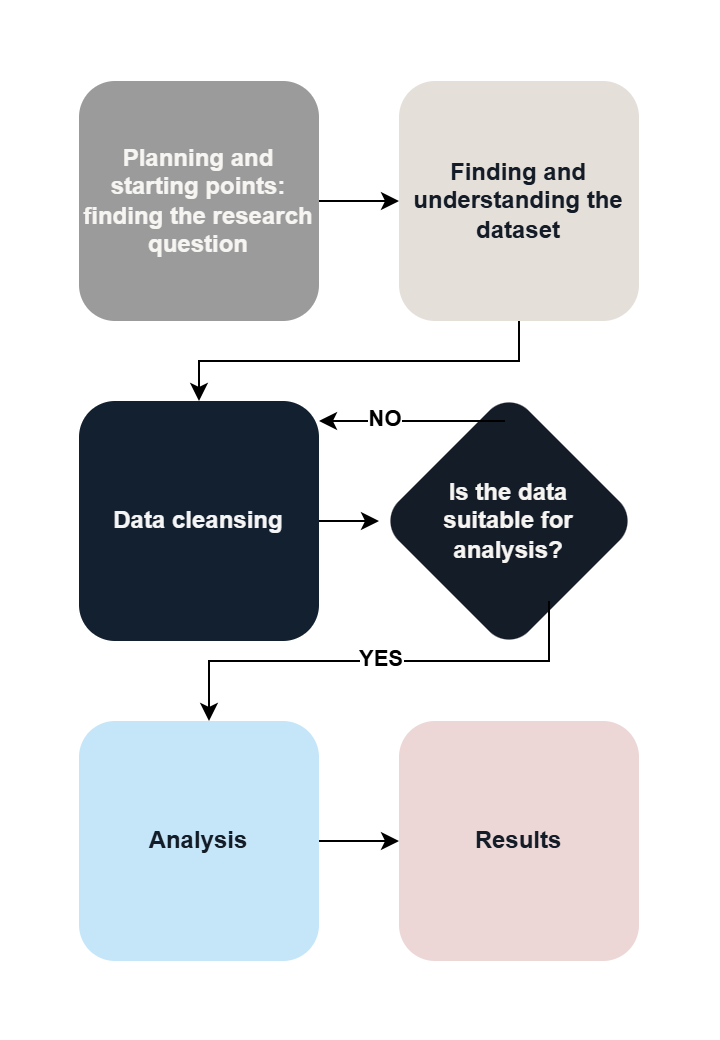
The team of researchers working in the lab documents their research processes so that, in line with the principles of open science, their studies are accessible and reproducible for others. At the heart of the lab is a collection of use cases that offers an overview of digital humanities methods and of the choices made during the research process. The workflow collection currently includes a selection of descriptions showing how lab researchers, participants in the HUM hackathon, and students from the University of Tartu course “Cultural Data Project” used digital methods to study humanities datasets. The workflows open up the choices made during research: how data was collected and cleaned, which tools were used, what problems arose, and how these were solved.
Workflows by the researchers’ working group: academic research questions and diverse materials
Members of the HUM Data Lab researchers’ working group have contributed to decisions about the methods used for describing workflows and have documented their own research processes. The workflow descriptions by the lab’s researchers are connected to their completed or ongoing articles and research projects.
Kata Maria Metsar and Tiina Kull from the Estonian National Museum described the process of conducting a pattern analysis of striped skirts. The aim of the workflow is to examine the pattern logic of Estonian striped skirts from the 18th and 19th centuries and how these patterns relate to fabrics produced at a factory in Norwich, England. The workflow shows how materials from different sources can be brought together into a comparative dataset and prepared for analysis using machine learning methods.
Aare Tool’s workflow description introduces how to make the metadata of musical works accessible. Together with other researchers from the Estonian Academy of Music and Theatre, he is analysing the dataset needed to compile a thematic-bibliographic catalogue of Heino Eller’s works. In Estonia, data related to musical works is fragmented across several information systems, such as MuIS, , ESTER, and the Estonian Music Information Centre. The workflow shows how a catalogue can be compiled on the basis of such information, with the aim of making musical information publicly accessible through a single search, while also helping other researchers find useful models for catalogue creation.
Monika Reppo and Mahendra Mahey from Tallinn University have described a workflow that shows how working photographs collected during object-based research can be used for the automatic identification of objects and the assessment of their condition, and how such a collection can be published. Monika Reppo has taken approximately 15,000 photographs of archaeological glass finds preserved in Estonian memory institutions. Monika and Mahendra’s workflow presents the steps needed to publish such a large dataset. Cleaned raw data can be used to train the computer vision capabilities of an AI model. As part of the workflow, the ability of a computer vision model to identify objects of the same type is tested. The workflow can support anyone wishing to make their research data publicly available, especially researchers working with object photographs.
Resarchers from the Estonian Literary Museum — Olha Petrovych, Mari Väina, Kaarel Veskis, and Liina Saarlo — have described their workflow for thematic analysis of Ukrainian and Estonian folk songs. The researchers created a comparative corpus of Ukrainian and Estonian folk songs and translated it into English using AI. This made it possible to study thematic overlap, cultural similarities, and topics specific to only one region. The workflow can serve as a model for corpus creation, translation, and thematic analysis.
Mark Mets describes a workflow on how to present large datasets in a visually clear and comparable way. A study carried out in cooperation between researchers from Tallinn University and the University of Vermont examined the frequency of mentions of the word “Ukraine” in 28 different languages over a period of 15 years in a Twitter dataset. The challenge was to find a suitable graph for presenting a large amount of data in an accessible way. The visualization helped analyse changes over time in the attention paid to Ukraine. This methodology could also serve as a starting point for the visualization and analysis of other time series.
The current workflow descriptions show the working practices of humanities researchers using digital methods. Over the course of this year, the Data Lab researchers will supplement these descriptions with code and data, with the aim of making the workflows reproducible.
HUM hackathon workflows: applications and playful solutions
Participants in the HUM hackathon, held in April 2026, also documented their work process. Three workflow descriptions are currently available on the lab’s workflow page. All hackathon projects showed what can be achieved with cultural heritage datasets in a short period of time — and which stages are central to creating a functioning prototype.
Team Think Floyd — Inna Lisniak, Hikmat Azimzade, and İbrahim Göktürk Kılcan — created an interactive application for the project “The Tunes of the World Map,” based on Estonian and Ukrainian folk song datasets. The application visualizes the origins of folk songs and shows which themes and emotions overlap in them and how they differ. The workflow description shows how the corpora were made comparable, how sentiment analysis was used, how the data was visualized in the application, and how it was made accessible through a search and query interface.
Working with materials from the National Archives’ database of historical building designs, the team Koodikratid — Emma Lauren Laikmaa, Mia Mõisnik, Kevin Peekmann, Siim Ilison, and Jon Kristof Aasmäe — created an interactive map application that allows users to explore the history of Tartu. The workflow describes how after cleaning the data, the work focused primarily on the application’s user interface, which offers several filters as well as a 3D model.
Team Digitondid — Manpreet Kaur, Bhumika Bhattacharyya, Danni Zhang, Hendrik Aruoja, Ka On Chan, Kristjan Volmer, and Yee Chun Tsoi — developed two projects by combining the curated national bibliography with parish court records preserved at the National Archives. In the first Digitondid project, users could explore through an interactive application the extent to which the same Estonian names appear both in court records and in book history. In the second project, they created a game that turned parish court records into an interactive courtroom simulation. As a workflow, they describe how the work began with understanding the datasets and carrying out exploratory analysis, and how it then split into two different project branches. A similar approach can also be used in other applications where information needs to be extracted and questions related to data structuring and design need to be solved.
Workflows from the University of Tartu course “Cultural Data Project”: learning digital humanities and open science methods through Literary Museum data
In the spring semester, the course “Cultural Data Project” was held in cooperation between the HUM Data Lab team and the University of Tartu. During the course, students used datasets from the Estonian Literary Museum, developed research questions in group work, and answered them by analysing data with digital humanities methods. The students were supported by mentors from the Literary Museum and the University of Tartu. In their research projects, the students used the runosong database, photograph collection, folk music data, and Seto wonder tales from the collections of the Estonian Folklore Archives, as well as the correspondence of Kreutzwald and Koidula from the materials of the Estonian Cultural History Archives. In addition to introducing data-driven analysis, the course included learning open science practices. The students also described their work processes in the form of HUM Data Lab workflows.
Otto-Albert Junk and Marta Lepson describe in their workflow “Analysis of Regional and Temporal Patterns in Estonian Folk Instrumental Music” the regional and temporal distribution of instruments and instrumental tunes based on materials preserved as instrumental pieces in the Estonian Folklore Archives. An important part of their work process was data harmonization and statistical overview, including map-based visualizations. Such stages of the work process are useful not only when working with metadata on instrumental tunes, but also when dealing with various kinds of archival material.
A large metadata table was also used by Kata Maria Metsar, Daria Andriyanovich, and Gabriel Ankov, whose aim was to study the spatial and temporal patterns of the photograph collection of the Estonian Folklore Archives and to make a large and difficult-to-grasp dataset easier for users to explore through an interactive visualization tool. Here, too, data cleaning was an important aspect, allowing the data to be presented in a practical and accessible way through a desktop application. They also experimented with adding keywords using machine learning.
Anastasiya Chertova, Helga-Mai Kivisild, and Marion Pilv described the literary network of the Estonian national awakening period on the basis of the correspondence between Koidula and Kreutzwald. The correspondence is accessible through the KORP query system. The students describe the process of identifying name forms, cleaning them, and visualizing them as a network. The workflow could also serve as a model for finding and analysing names in other datasets.
Mirelle Kiholane and Helena Kalm worked with the Estonian runosong database to study the geographical distribution of work songs mentioning grains and to analyse which grains were most frequently mentioned in different regions. The students created an SQL script for searching the database and visualized the results as bar charts and maps.
Aleksander Amos Nigesen and Gretta Nikolajeva analysed the tale type 567(A), “The Magic Bird,” on the basis of Seto fairy tales. The story of gaining special abilities after eating a magical bird varies in many ways — the students combined qualitative and quantitative methods to study this variation, for example to identify subtypes. This work process may also be useful for studying other tale types.
Conclusion: workflows as models for planning the analysis of humanities datasets
The workflow descriptions show how diverse the research projects and applications created using digital humanities methods can be. Many of the workflow descriptions include links to code repositories. The textual descriptions and diagrams of the workflows help make it easier to understand the stages involved in data-intensive research or in creating applications based on cultural data.
Explore the workflows on the HUM Data Lab website and use them when planning your own research project, course, or data-based application. Would you like present your own project in the lab? On the lab’s website, you will also find information on how to add your own project in the lab environment.