Past Lives in Estonian Cultural Data – Developing Interactive Exhibits with 19th Century Parish Court Records and Bibliographical Data

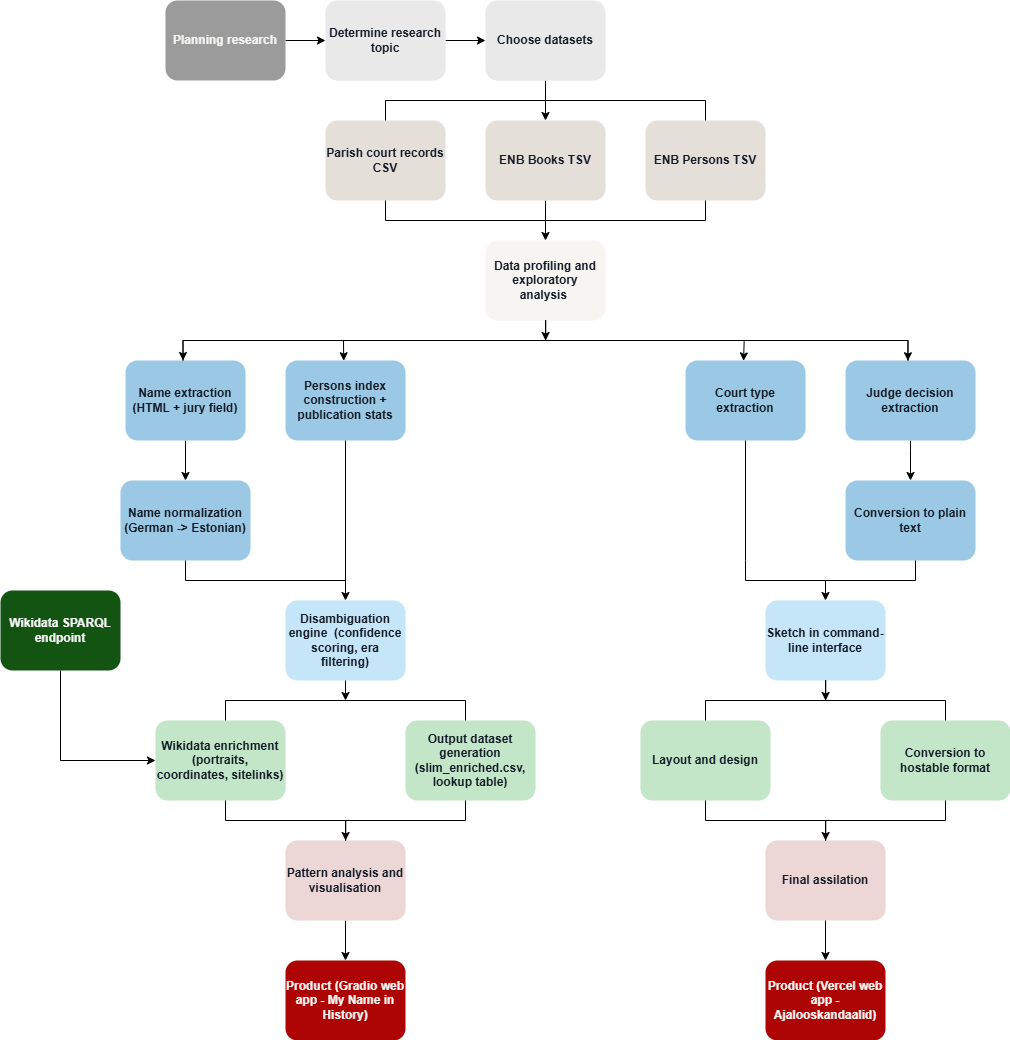
The workflow addresses how 19th-century Estonian parish court records and bibliographical data can be transformed into interactive digital exhibits for the general public. Although these datasets contain rich historical and cultural elements, they are not immediately accessible to non-specialist audiences in their original structured forms. The workflow therefore explores how cultural heritage data can be cleaned, extracted, linked, and redesigned as interactive applications.

The research question is how these datasets can be processed and combined to support meaningful public engagement with Estonian cultural history. To answer this, the workflow develops two related prototypes. My Name in History allows users to search family names and receive historically contextualized results by linking parish court records with bibliographical and person-related data. On the other hand, Ajalooskandaalid transforms parish court cases into a game-like judging experience, where users interpret a historical case and compare their decision with the original court outcome. The goal of the workflow is not only to produce two web prototypes, but also to document a reusable process for converting archival and bibliographical datasets into accessible, interpretive, and interactive cultural heritage applications.

Workflow steps

Keywords: contextualizing, discovering, gathering

The purpose was to define the shared research direction of the project before developing the two digital products. The project started from the broader aim of making 19th-century Estonian cultural data more accessible to public audiences. Instead of treating archival and bibliographic datasets only as research materials, we wanted to explore how they could support interactive experiences where users could search, interpret, and engage with historical records.

We used three main data files. The parish court records were provided as parish_courts_full_dataset.csv, licensed by the National Archives of Estonia. The dataset is no longer publicly accessible after the end of the hackathon. The bibliographical data were provided as two TSV files, enb_books.tsv and persons.tsv, licensed by National Library of Estonia, and are available through https://digilab.rara.ee/en/datasets/curated-enb/.

These datasets created a foundation for two branches of the project, one focused on tracing names across parish court records and bibliographical data, and another focused on turning parish court cases into a game-like interpretive experience. The workflow focused on the 19th century because the parish court dataset used in the project covers this period, while the Estonian National Bibliography datasets have broader temporal coverage. To make them comparable and meaningful for linking, we have limited the study period to the 19th century. The main constraints were the semi-structured form of the parish court records, including HTML-like text and historically variable name forms, and the temporal coverage of the bibliographical datasets.

Keywords: analyzing, exploration, data visualization

This is to understand what the three datasets contained and realistically support. We examined the structure of the parish court records, the available fields, the format of the text, and the presence of names, case types, and court decisions. For the Estonian national bibliographic datasets, we looked at personal names, publication information, dates, identifiers, and links to external authority data where available.

This profiling stage showed that the same source material could support two different outputs through different methods. The name-related fields and person/publication data made it possible to build the My Name in Historybranch, while the case descriptions, court types, and decision-related text made it possible to build the Ajalooskandaalidbranch. In this sense, this step acted as the bridge between the initial dataset selection and the later product-specific processing.

Keywords: extracting, transformation, text categorization

This step was to clean and extract the parts of the metadata that were needed for the later workflow. Relevant information was embedded in semi-structured HTML-like text, so HTML parsing and text cleaning were first used to remove markup and convert the content into a more readable form. Regular expressions were then used to identify and extract selected case information, including descriptions, hearing outcomes, and other text patterns needed for the two product branches.

This step supports the two branches in different ways. For My Name in History , the key task was extracting names from HTML content and jury-related fields, because these names later become the basis for linking court records with bibliographic person data. For Ajalooskandaalid , the focus was on extracting hearing outcomes from HTML text, because they become the interactive material of the judging game.

Keywords: mapping, gamification

Here, we processed the extracted information into a more structured form for matching, analysis, and interaction. For My Name in History , this meant normalizing historical name variants, building a persons index, calculating publication-related information, and using a disambiguation engine to compare names across sources. The matching process uses confidence scoring and era filtering because historical person identification is uncertain and should not be treated as a simple exact-match problem.

For Ajalooskandaalid, this stage involved testing whether the extracted data could support meaningful interactions before building a more polished user experience. A command-line sketch was used to check the basic game logic, including presenting a case, asking the user to make a judgement, and revealing the historical answer. In both branches, this step turns raw extracted elements into structured, tested material that can be used for enrichment, design, and product development.

Keywords: enriching, Linked Open Data, analyzing, data visualization, design

The purpose of this step was to add context to the processed data and shape how users can engage with it. For My Name in History , matched persons could be enriched through Wikidata using the SPARQL endpoint, which allows structured connection from Wikidata to be queried and reused where available. This made it possible to add information such as portraits, places, coordinates, sitelinks, and other contextual details. The enriched data could then be used for pattern analysis and visualization, showing connections between court appearances, names, places, and publication activity.

For Ajalooskandaalid, the step focussed on layout and design in this stage. The question here was not how to enrich extracted data, but how to make parish court cases understandable and engaging for users. The design had to present historical text clearly, provide simple choices, and create the feeling of interpreting a court case without overwhelming the users. This step moves from processed data toward interpretation: one through enrichment and visual analysis, the other through interface design and game experience.

Keywords: creating, publishing, dissemination, design

The final step of the project was to turn the processed datasets, analysis, and interface ideas into public-facing web applications. My Name in History was implemented as a Gradio prototype for searching a name and receiving historically contextualized results based on 19th-century Estonian parish court records and bibliographical data. Its public hosting has now expired, but the code is available in the shared GitHub repository and can be reproduced from there

Ajalooskandaalid was implemented as a Vercel-hosted web app that turns parish court cases into a gamified judge-simulator experience. The case descriptions and hearing outcome data are integrated into the interaction logic and user experience, allowing users to interpret a historical case and compare their decision with the original court outcome. As the parish court dataset is restricted by licensing conditions, users are expected to have access to the parish court CSV file and upload it themselves when using the application. The code for both prototypes is stored in the shared GitHub repository, which also provides the practical basis for reproducing the workflow and running the applications.