
Pattern Analysis of Striped Skirts

This workflow describes how image-based patterns are compared using machine learning methods. The aim is to investigate the pattern logic that characterised Estonian striped skirts of the 18th–19th centuries and to examine how these patterns relate to striped, glazed-surface woollen callimanco fabrics produced at the Norwich factory in England. The workflow combines digital humanities approaches with machine learning. For analysing large image datasets, we use machine learning models designed for visual pattern recognition, specifically convolutional neural networks (CNNs). CNNs are used primarily for extracting visual features and assessing pattern similarity, rather than for training a new model from scratch. Using CNNs, we compare stripe rhythms, colour usage, and structural features, and identify possible similarities between the two textile types. The central research question is whether Estonian folk costume skirts were inspired by specific imported fabrics, and which visual features best explain this relationship.
The workflow describes the process from collecting and standardising images from museum collections to interpreting the results of pattern analysis. At present, the research is in the phase of interpreting analytical results.
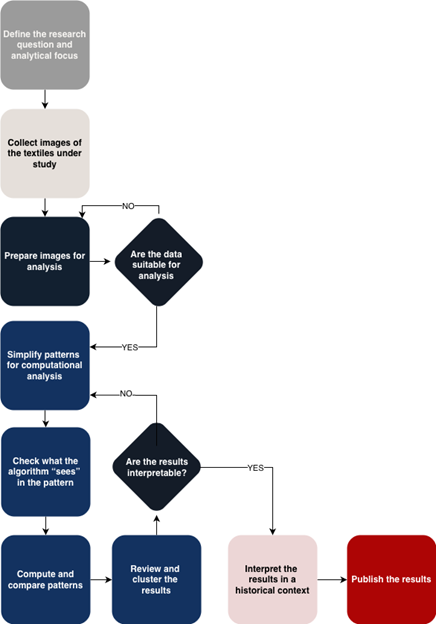
Workflow steps

Keywords: Discovering, Collecting, Contextualizing, Information retrieval

Goal

At this stage, we compile the visual sources required for the research. For Estonian material, our primary focus is on the collections of the Estonian National Museum, which are publicly accessible through the MUIS web portal. In addition, we collect photographs of Norwich callimanco fabrics originating from England, sourced from sales catalogues and factory dispatch books. This stage also includes contacting various museums and textile researchers to identify as representative and comparable an image corpus as possible.

Relation to the workflow

The aggregation of sources forms the foundation for all subsequent digital analysis. Without a sufficiently large dataset, it is not possible to statistically describe pattern variability or evaluate machine learning models. This stage establishes which stripe patterns are comparable and to what extent Estonian skirts can be examined alongside the callimanco tradition. All subsequent steps in the workflow depend on the visual corpus being compiled in a thorough and transparent manner.

Keywords: Transformation, Preprocessing

Goal

The purpose of this step is to prepare museum photographs into a unified and comparable image corpus for further analysis. As the photographs were taken under highly varied conditions (lighting, perspective, scale), preprocessing is required to create a consistent basis for comparison. Each stripe segment is cropped at a standard scale (10 and 20 cm for Estonian material; 9 and 21 cm for callimanco), and image orientation is corrected where necessary, as even slight tilts can produce misleading results in machine learning. All stripe images are organised into folders by size and origin—separating Estonian and English material, and approximately 10 cm and 20 cm scales. Image processing is carried out manually using GIMP, and images are initially stored in Google Drive and the Estonian National Museum’s OneDrive.

Relation to the workflow

Consistent image preprocessing is critical for machine learning. CNN models are sensitive to visual noise and may otherwise learn irrelevant signals (such as shadows, lighting conditions, or photographic quality) instead of pattern logic. The outcome of this stage is a standardised, machine-learning-ready image corpus that allows for reliable identification of structural similarities and differences in stripe patterns.

Keywords: Transformation, Preprocessing

Goal

The aim of this step is to reduce visual noise in the image material and to transform textile patterns into a form suitable for analysis. Methods are applied to emphasise the core structure of stripe patterns, such as colour-field harmonisation, brightness normalisation, and reduction of the pattern into one- or multi-dimensional signals.
In addition, essential and non-essential pattern elements are distinguished so that subsequent analysis focuses on stripe rhythm, boundaries, and width relationships rather than incidental photographic variation.

Relation to the workflow

This step establishes the conditions for all subsequent analytical stages. Without pattern reduction and noise minimisation, colour-based, rhythm-based, and deep-learning methods may respond to irrelevant visual signals. Pattern preprocessing helps ensure that computational analysis treats the textile as a pattern rather than as a photograph.

Keywords: Annotating, Identifying, Visual analysis

Goal

Before applying computational analysis methods, we define which visual pattern features are substantively relevant for comparison. The focus is on stripe rhythm, the distribution of colour groups, relationships between stripe widths, and the formation of pattern boundaries.
This step uses visual comparisons at different scales, a limited number of manually annotated examples, and the interpretation of intermediate results.
Annotation does not function here as a separate training dataset, but as a control mechanism that helps assess whether the system is “looking at the right thing” or drifting toward irrelevant photographic features.

Relation to the workflow

This step connects human pattern perception with computational analysis. Without such control, it is not possible to evaluate whether subsequent colour-based, rhythm-based, and deep-learning methods produce meaningful results. The step prepares the ground for the next analytical phase.

Keywords: Analyzing, Pattern recognition, Machine learning

Goal

At this stage, visual features of the textiles are computed at multiple levels. The analysis includes the distribution and proportion of colour palettes, stripe segment widths and rhythmic sequences, and the structural characteristics of pattern boundaries. These features are examined both independently and in relation to one another.
In parallel, pre-trained convolutional neural networks (CNNs) are applied to describe overall deep visual similarity between patterns and to compare these results with other, more interpretable features.
Different features describe patterns from different perspectives, allowing us to assess whether similarity arises from colour usage, rhythm, structure, or a combination of these elements.

Relation to the workflow

Multi-level feature analysis prevents reliance on a single method and provides a basis for flexible and interpretable pattern comparison.

Keywords: Analyzing, Exploration, Visual analysis

Goal

We analyse the outputs of different computational methods using both quantitative metrics and visual comparisons. We examine the frequency of recurring patterns, the distribution of structural similarities, and the clustering of patterns. We identify which stripes show the closest correspondence between Estonia and England, and which skirts form distinct visual groups.

Relation to the workflow

This stage builds a bridge between the technical outputs of machine learning and cultural-historical research. The analysis provides initial evidence as to whether the detected patterns may indicate callimanco influence or instead reflect an independent Estonian tradition. It also helps evaluate the strengths and limitations of the model.

Keywords: Interpreting, Contextualizing

Goal

We relate the patterns identified by the model to ethnographic, historical, and art-historical material. We analyse how stripes cluster according to regions, periods, or technical characteristics, and in which respects Estonian patterns overlap with or diverge from the callimanco tradition

Relation to the workflow

Interpretation may indicate the need to include additional comparative material (e.g. Swedish, Latvian, or German textiles), refine model parameters, or re-examine specific skirts. This stage provides the basis for scholarly articles and doctoral dissertation conclusions.

Keywords: Disseminating, Publishing

Goal

If the research results are sufficiently robust and compelling, they are prepared for publication in articles, conference presentations, or visualised data publications. The methodology is also documented to enable other researchers to apply a similar approach. In addition, the datasets used are deposited in an appropriate repository.

Relation to the workflow

Dissemination concludes the workflow cycle while enabling new research. Feedback allows both the model and cultural-historical interpretation to be refined, strengthening collaboration between digital humanities and folk costume studies.