Literary Network of the National Awakening Based on the Correspondence of Koidula and Kreutzwald

This workflow was created to analyse the correspondence between Friedrich Reinhold Kreutzwald and Lydia Koidula from the years 1867–1873 and to map which people appear most frequently in the literary network of the National Awakening on the basis of these letters. The correspondence is one of the most important sources in Estonian literary history, reflecting the development of the national movement, cultural contacts, and relationships between authors. The workflow makes it possible to automatically identify personal names in a text corpus, clean and standardise name forms, and create a structured dataset that can be used to study which figures were most central in the cultural field of the National Awakening.


The output of this workflow is a cleaned dataset of personal names, a frequency analysis, and a network visualisation showing which people appear most frequently in the correspondence of Koidula and Kreutzwald. This approach helps us understand the structure of the literary field of the National Awakening in a new way, offering quantitative support for literary-historical interpretations and making it possible to see which lines of communication and influence shaped the formation of Estonian national literature.

Workflow steps

Keywords: annotating, extracting

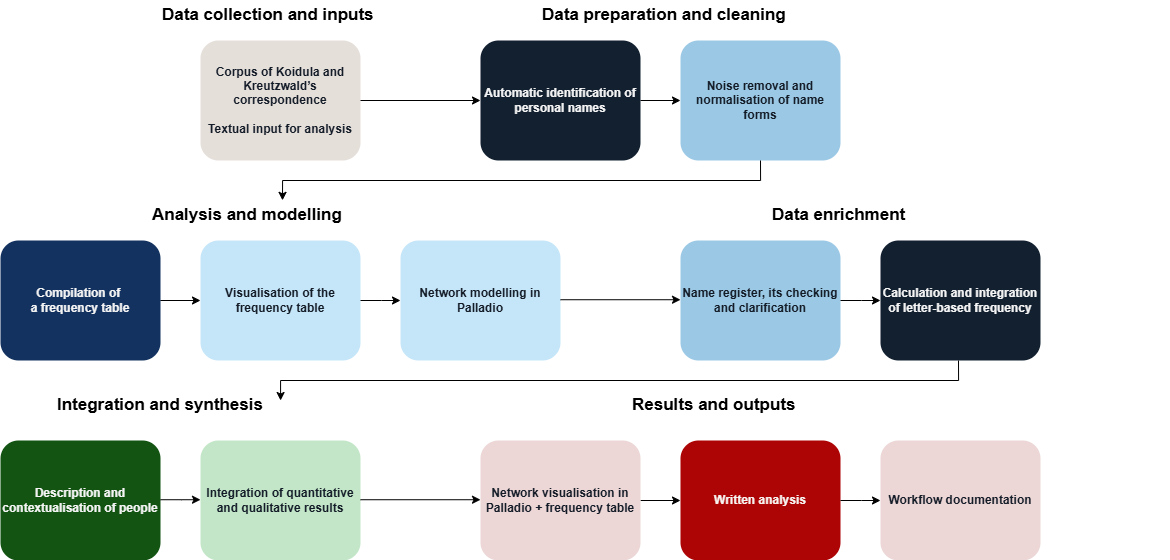
The aim here is to find all personal names in the texts of the correspondence, as these form the basic elements of the later network. We use automatic named entity recognition in the corpus of Kreutzwald and Koidula , which marks the places in the text where a personal name begins (B-PER) and where the name continues (I-PER). This makes it possible to quickly and systematically extract all potential people mentioned in the correspondence together with their frequencies of occurrence.
Automatic annotation is necessary because searching for names manually would be time-consuming and probably also inconsistent. The output of this stage is an initial list of name candidates, which then moves on to the cleaning and normalisation step.

Keywords: data cleansing, enriching

Automatic identification also produces noise: in this context, incorrectly identified words, broken name forms, and repeated forms. The dataset therefore needs to be cleaned of all irrelevant elements, and different name variants must be combined into single individuals. For example, we combine inflected forms (“Jakobsoni”), abbreviations (“Carl”), and alternative spellings (“Jacobson”) under one correct name.
In addition, we combine first names and surnames, for example “Lydia” and “Koidula”, into one person, and, where necessary, add roles such as family, colleagues, or scholars. This enriches the dataset and ensures that the later analysis is based on accurate and standardised data.

Keywords: analyzing, data visualization

On the basis of the cleaned data, we create a frequency table showing how often different people are mentioned in the correspondence. This provides an initial overview of which figures were most visible in the literary communication space of the National Awakening. On the basis of the frequency table, we also create a bar chart, which helps make the results visually understandable.

This stage is important because it creates a quantitative basis for the network analysis. Frequency indicators help identify central figures around whom the network will later be modelled.

Keywords: Data cleansing, enriching

At this stage, we began working with a new, complete name register that we received from the supervisor(s) together with feedback. Since the earlier automatic NER identification missed some people or identified them incorrectly, we essentially began checking the data from the beginning. On the basis of this name register, we examined not only simple frequency of occurrence, but also a frequency measure showing in how many letters each person appeared. The previously created frequency table is also correct; it simply contains the total frequency of names.

We compiled the list of people again, assigned role categories to each person, such as family, public figures, and scholars, and calculated mention / occurrence frequencies. Lydia Koidula and Friedrich Reinhold Kreutzwald were added to the list manually, because they are the central points of the network, and without them the network analysis would have been quite empty.

As a result, updated frequency tables, bar charts, and the letter-occurrence tables needed for Palladio were created. Data accuracy and manual checking are especially important in the case of historical texts, where automatic annotation is not always sufficient.

Keywords: enriching, analyzing

After cleaning the data and assigning roles on the basis of the name register, we calculated each person’s letter-based frequency of occurrence, using the page numbers in the name register. While total frequency shows how many times a name is mentioned, letter-based frequency shows in how many different letters the person appears. This metric reflects the actual communication network more accurately. We created a new table that distinguishes between total frequency and letter-based frequency, and selected the 13 most frequent people for analysis, since the occurrence frequencies of the following people were already so low that they seemed relatively unimportant in the context of the network. We integrated the results into the document containing descriptions of the people and prepared the dataset for creating the network in Palladio.

Keywords: analyzing, modelling, data visualization

The next step is to create a network between the people, showing which figures appear most frequently in the correspondence. We use the Palladio environment, into which we import the cleaned dataset and create a graph representing frequencies.
We filter out noise elements, such as “Other / Unidentified”, so that the graph is clear and focuses on the important people. The result is a visual model of the literary communication network of the National Awakening, based on the correspondence of Koidula and Kreutzwald.

Keywords: enriching, analyzing, interpreting

After modelling and visualising the network, we create short descriptions of the people who appear most frequently in order to connect the quantitative results with the cultural and literary-historical background of the National Awakening. The aim of this stage is to understand why these particular people stand out in the networks, what role they played in the lives of Koidula and Kreutzwald, and how they relate to the broader context of the national movement. The short descriptions are based on reliable sources, such as materials from the Estonian Cultural History Archives, the Kreutzwald portal, and others, as well as on connections found in the correspondence.

This stage helps interpret the structure of the network in terms of content, showing how family ties, national contacts, and the network of scholars reflect the functioning of the cultural field of the National Awakening. Describing the people connects digital analysis with literary-historical interpretation and enables us to understand why certain nodes become central in the network and what role they played in nineteenth-century Estonian culture.

Keywords: interpreting

At this stage, we connected the quantitative results with the literary history of the National Awakening. We compared total frequency and letter-based frequency in order to understand which people were stable participants in the correspondence and which appeared more thematically or episodically.
Letter-based frequency made it possible to identify people who were more important in the actual communication network of the correspondence, even if their total frequency may have been lower. We interpreted the results through the roles of Koidula and Kreutzwald in the cultural field of the National Awakening, highlighting family, professional, and international contacts. This step connects the technical analysis with the research question and shows how digital methods open up new perspectives for understanding historical texts.