
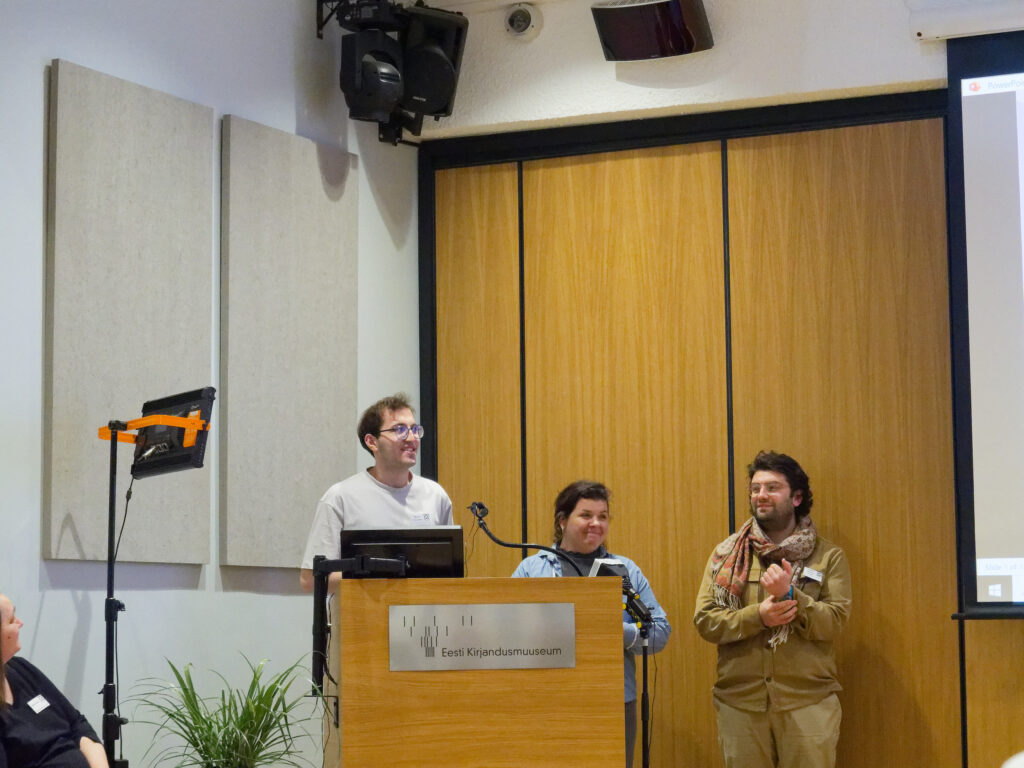
During 17-19 April 2026 in HUM hackathon, interdisciplinary teams worked with cultural heritage data during one intensive weekend. For the winning team of the HUM Data Lab Hackathon, the result of the weekend was "Tunes of the World Map" — an interactive project exploring Estonian and Ukrainian folk songs through digital textual analysis and map-based visualisation.
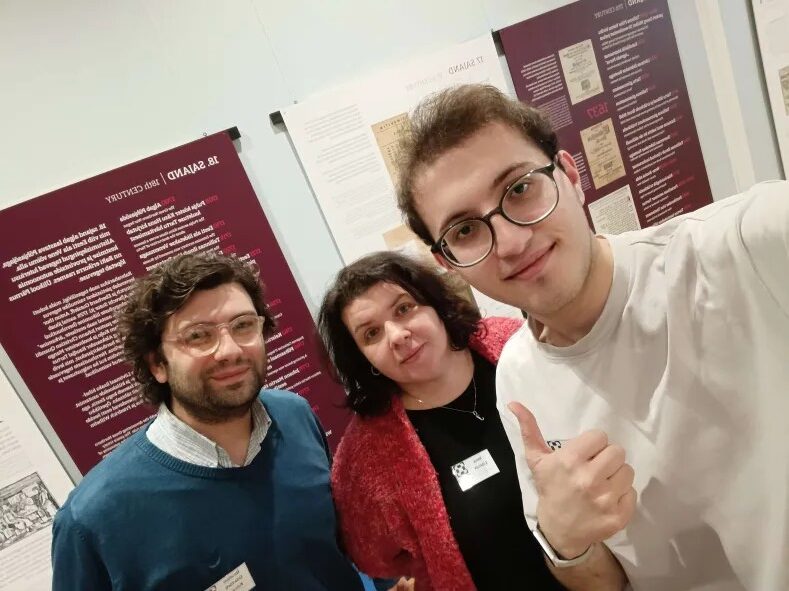
The team, Think Floyd, brought together three participants with different professional and cultural backgrounds: İbrahim Göktürk Kılcan, an art historian and archaeologist from Turkey; Hikmat Azimzade, a computer scientist from Azerbaijan; and Inna Lisniak, a musicologist from Ukraine. They had a goal to make folk song traditions more engaging.
Their project focused on the textual analysis of Estonian and Ukrainian folk songs. From the beginning, the team was interested in finding ways to present it to wider audiences. As Inna explains, the project aimed to combine humanities research with computational approaches in order to better understand folk song traditions and make cultural data more accessible, especially for younger researchers.
From Many Ideas to One Interactive Map
The team did not start with a single fixed idea. At first, several possibilities were on the table. One direction was more strongly data-scientific: classifying songs by genre, identifying formulaic patterns, and conducting exploratory analysis of the corpus. Another idea was to build a Spotify-connected website that would recommend folk songs based on a user’s listening habits. A third possibility was a broader interactive platform for exploring the songs.
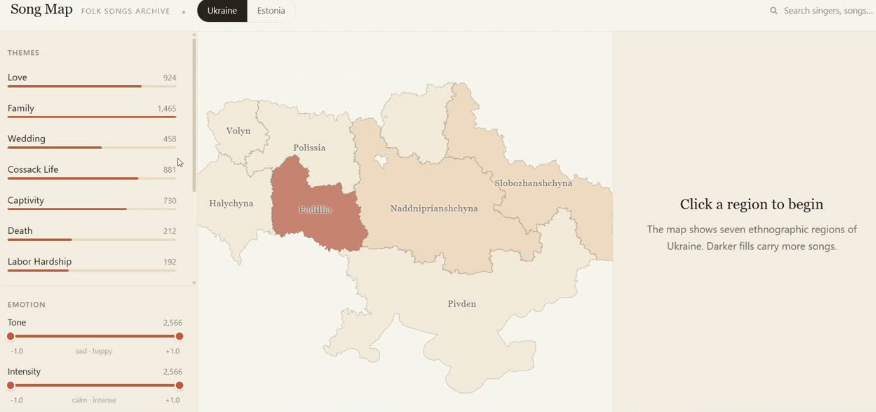
During the hackathon weekend, these ideas gradually converged. The map became a central element early on, helping to ground the songs geographically. With support from mentors, the team then added keyword-based exploration, thematic classification, and an emotion slider that allowed users to filter songs along a happy–sad spectrum.
By the end of the weekend, the result combined analytical depth with an accessible and engaging interface. The project was presented as a way of asking how folk song collections can be explored across linguistic, geographical, and emotional dimensions.
Working with Messy, Meaningful Data
One of the most important lessons for the team was that cultural heritage data does not behave like a clean, ready-made dataset. Folk song archives were not originally created for computational analysis. They were compiled by ethnographers, collectors, and researchers who were interested in singers, regions, performance contexts, and oral tradition.
But this was not a problem. Göktürk stated: “It turns out that the messiness is part of the charm!”
The team also realised that the size of a dataset does not automatically make it meaningful. Even a corpus of 142,000 songs becomes interesting only when researchers ask specific questions. In this sense, the project was not about letting the data “speak for itself”, but about building thoughtful ways to explore it.
The comparison between Estonian and Ukrainian folk songs also brought methodological challenges. The two traditions belong to different linguistic and cultural contexts, which made direct comparison difficult. The team therefore had to think carefully about how to analyse and present the materials while still respecting the specific character of each tradition.
A Team Built on Complementary Strengths
The division of work within the interdisciplinary team developed naturally. Hikmat, with his computer science background, focused on building the interactive map, visualisations, and technical connections between the analysis and the frontend. Inna worked closely with the datasets, concentrating on the interpretation of similarities and differences in the folk song material. Göktürk contributed to the research framing, presentation, and visual design.
At the same time, the work was not divided into isolated tasks. The team emphasised that the process was collaborative and iterative. They regularly checked whether the technical outputs still made sense in relation to the cultural questions. This dialogue between technical development and humanities interpretation became one of the project’s strengths.
The tools they used reflected the hybrid character of the work. For exploratory data analysis, the team used Python, pandas, Google Colab, and visualisation libraries. They also experimented with AI tools such as Claude and Gemini for coding support and exploration. The presentation was created in Canva, with some light assistance from Claude, although the team emphasised that most of the writing and conceptual work was their own.
What the Team Learned
For Think Floyd, the hackathon demonstrated that working with cultural heritage data requires both accuracy and creativity. The data must be handled carefully, with attention to context, structure, and limitations. At the same time, meaningful engagement with such material often depends on innovative presentation formats and experimental methods.
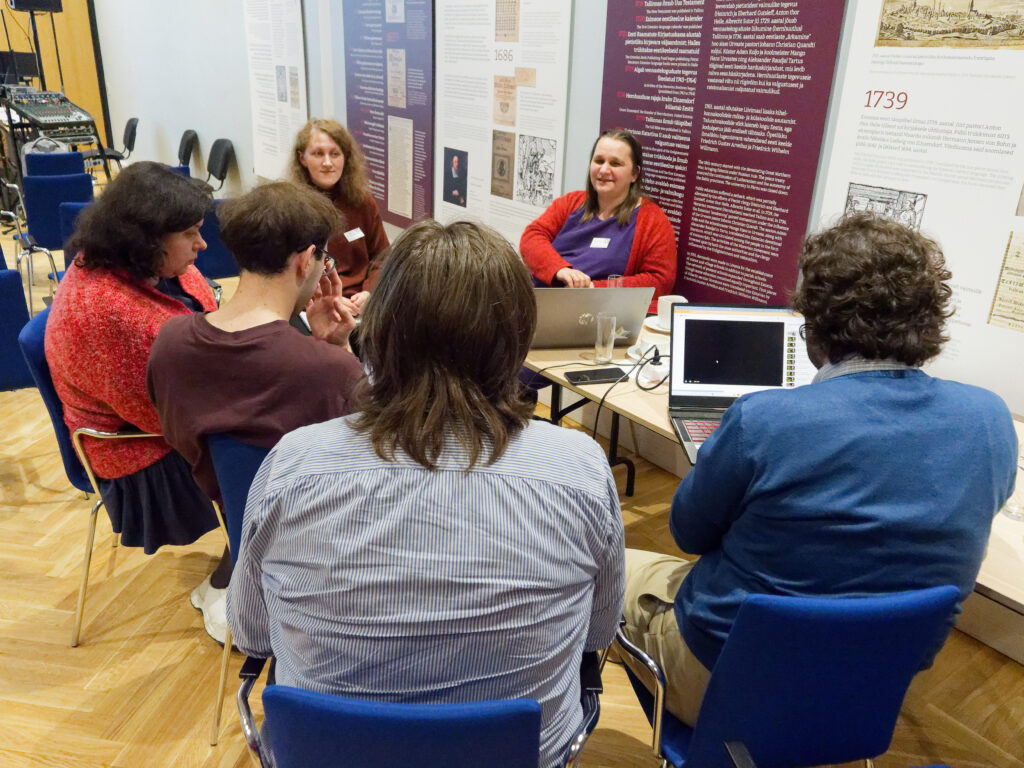
The team also highlighted the value of the hackathon format itself. Three days of intensive brainstorming, teamwork, and mentoring can lead to surprisingly rich results. The event gave participants space to test ideas quickly, learn from mentors, and combine different forms of expertise.
Their advice to future participants is simple: “Stay open to new ideas and don't get attached to your first solution . The focus should be the problem, not the product. Listen to the mentors, their advice genuinely shaped our project. Work as a team and lean on each member's strengths. And most importantly, build something cool and have fun!”
What next?
The team sees “Tunes of the World Map” not as a finished product, but as a prototype with room to grow. If they had more time, one priority would be to expand the geographic scope beyond Estonia and Ukraine, allowing other folk song traditions to be added. Another goal would be to improve the filtering and drill-down functions of the map, so that users could move smoothly from country-level views to ethnographic regions, individual singers, and full song lyrics.
In its current form, the project already shows the potential of combining cultural heritage collections, computational analysis, and interactive design. It suggests how folk song archives can be opened up for new forms of exploration — not only for researchers, but also for students, educators, and wider audiences interested in cultural traditions.