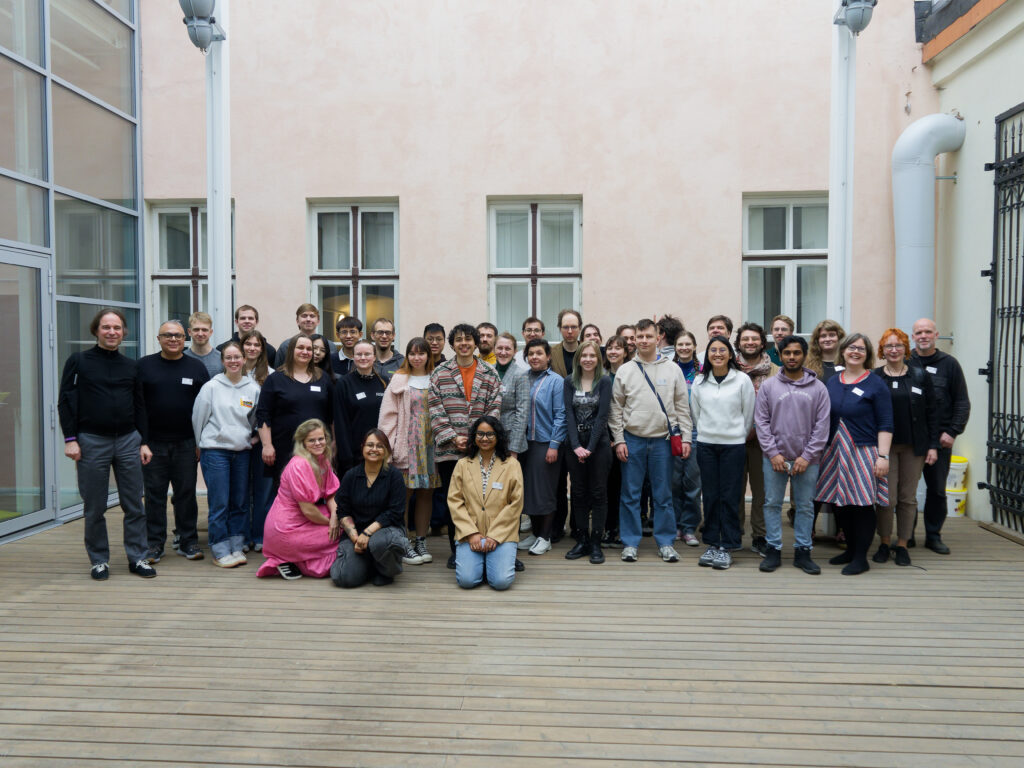
The HUM Data Lab organized the Cultural Data Hackathon on 17–19 April in Tartu, at the Estonian Literary Museum, with the aim of bringing rich cultural heritage datasets into broader and more diverse use. The hackathon was organized by members of the lab: Kaisa Langer (Estonian Literary Museum), Mahendra Mahey (Tallinn University), Mark Mets (Estonian Literary Museum / Tallinn University), Kata Maria Metsar (Estonian National Museum), Aare Tool (Estonian Academy of Music and Theatre), Olha Petrovych (Estonian Literary Museum), and Mari Väina (Estonian Literary Museum). The event was aimed primarily at students, but all interested participants were welcome.
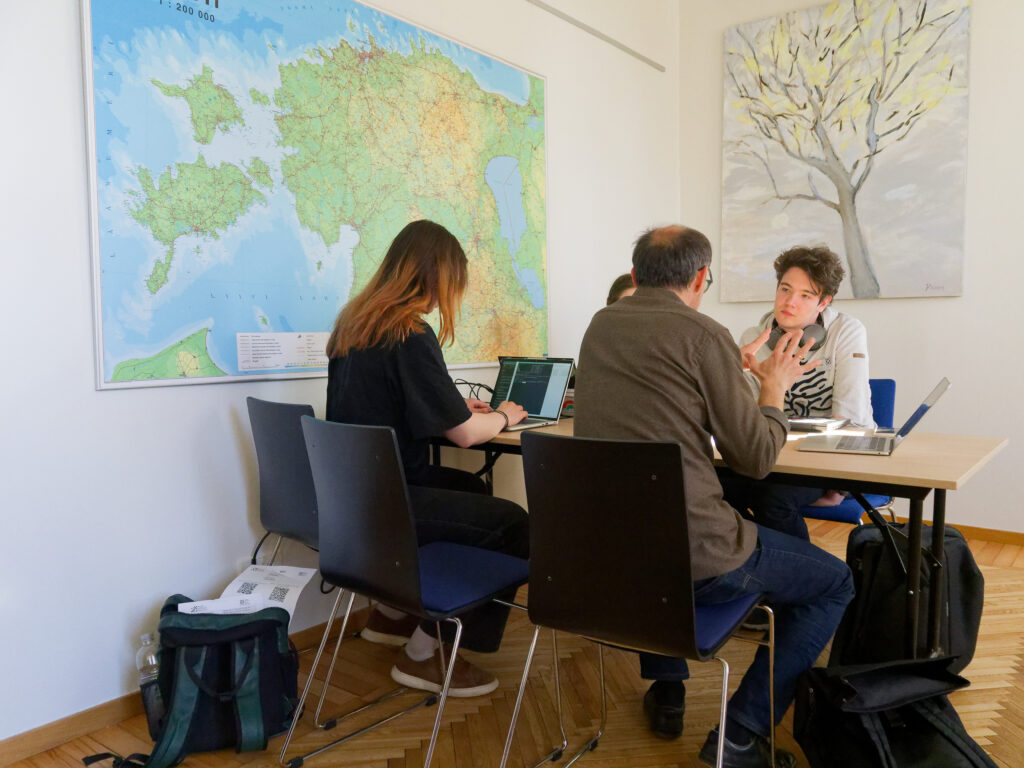
From the 25 participants who registered for the hackathon, six teams took shape. Over the course of three days, they explored the datasets, developed ideas for new, engaging, or useful ways of working with them, and brought those ideas to life as initial prototypes, experiments, or more fully developed solutions.
No Game, No Life (Maria Laura Alcaraz Vargas, Naveen Kumar Kandhasamypalyam Kulandhaivel, Nuntakarn Bootnoi) built a video game titled Aleksei’s Finno-Ugric Journeys. In the game, the player travels with a character named Aleksei, inspired by the ethnographer Aleksei Peterson, through the Finno-Ugric world, collecting different cultural objects.
Digitondid (Manpreet Kaur, Bhumika Bhattacharyya, Danni Zhang, Hendrik Aruoja, Ka On Chan, Kristjan Volmer, Yee Chun Tsoi) developed two projects. The first transformed rural court records into an interactive courtroom simulation in which participants can act as historical judges. The second enabled users to explore the extent to which the same Estonian names appear both in court records and in book history.
Jojo (Katarina Kahre, Semjon Fedun) created an interactive archival game based on the correspondence between Lydia Koidula and Friedrich Reinhold Kreutzwald, encouraging participants to reflect on how dialogue unfolds and develops through letters.
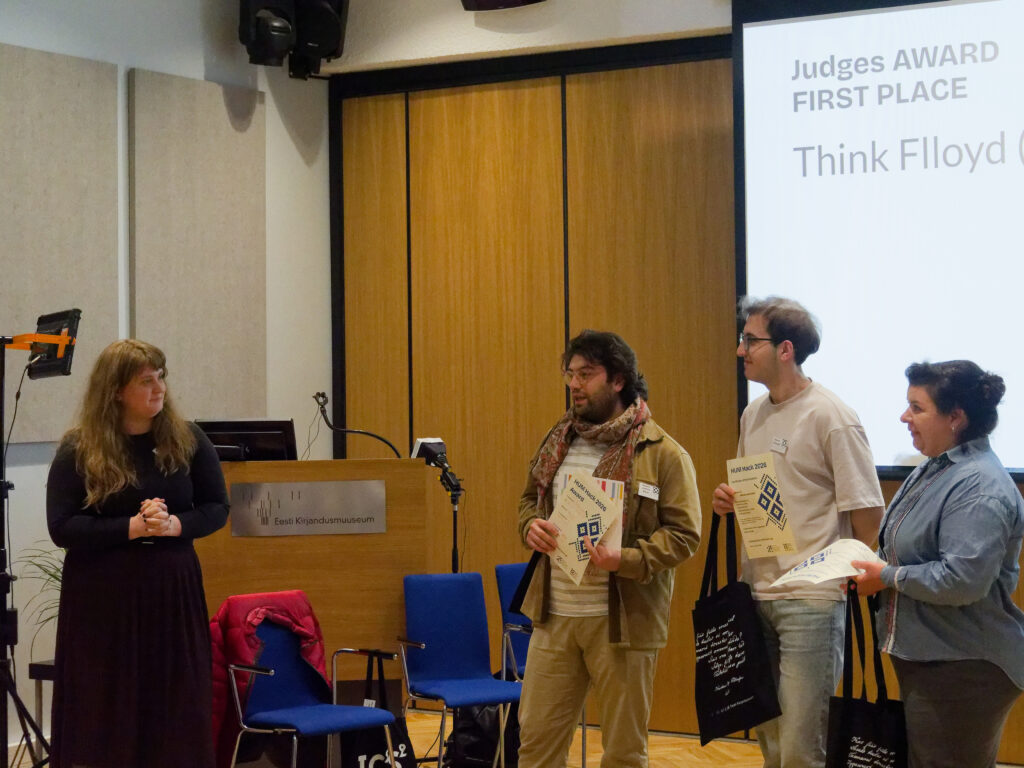
Think Floyd Think Floyd (Inna Lisniak, Hikmat Azimzade, İbrahim Göktürk Kılcan) created an interactive map visualizing the origins of folk songs and showing which themes and emotions they share and where they differ.
Puzzled Maniacs Puzzled Maniacs (Maare Karmen Oras, Adeline Talvik, András Borbély, Kristýna Bednářová) worked with data from the Estonian translated literature database and transformed its current spreadsheet into a relational database with a clearer structure and better user experience.
Koodikratid Koodikratid (Emma Lauren Laikmaa, Mia Mõisnik, Kevin Peekmann, Siim Ilison, Jon Kristof Aasmäe) built an interactive map application based on a database of historical building plans from Tartu. The application allows users to explore the city’s development layer by layer, building by building, and to see what historical buildings once looked like.
The teams were supported by data mentors from various research and memory institutions who had selected and prepared the datasets for the hackathon and helped participants understand their nature and context: Mari Väina, Olha Petrovych, Marin Laak, and Kadri Vider from the Estonian Literary Museum, Agnes Aljas ja Piret Koosa from the Estonian National Museum; Daniele Monticelli from Tallinn University; Laura Nemvalts from the National Library of Estonia ; and Sven Lepa from the National Archives of Estonia.
In addition to the data mentors, the teams were supported throughout the hackathon by technical mentors, who helped them tackle more complex questions and challenges: Mark Mets, Mahendra Mahey, Yan Asadchy, Laura Nemvalts, Jaagup Kippar, Hanna Uutsalu, and Gabriel Alonso Chavarria Chaves.
Inspirational talks about hackathon experiences were given by Mahendra Mahey, Hanna Uutsalu, and Gabriel Alonso Chavarria Chaves. the possibilities and recent developments of the Estonian museum information system, Museums Public Portal (MuIS) were introduced by Madli Pärn from the Estonian Heritage Board.
The hackathon’s independent jury, consisting of Maximilian Schich, Margaret Aidla, and Joshua Wilbur, decided to award the prizes as follows:
 1st place: Think Floyd
 2nd place: Puzzled Maniacs
 3rd place: Koodikratid
The Audience Award was shared equally by Think Floyd and Koodikratid.
Congratulations to the winners!
In addition to the organizing institutions, the hackathon prizes were supported by the Tallinn Business Incubator and Rahva Raamat.
Many thanks to all participants, mentors, jury members, speakers, partners, and supporters!
The hackathon brought together people from different memory and research institutions, who jointly encouraged young people to engage creatively with cultural data and to reflect on its content and value. It also showed that collaboration between IT and the humanities can make cultural heritage shine in new ways.