Mozarteum Foundation Salzburg and The Packard Humanities Institute; Introduced in Hackathon by Estonian Academy of Music and Theatre
Machine-readable notation helps to understand Mozart’s music
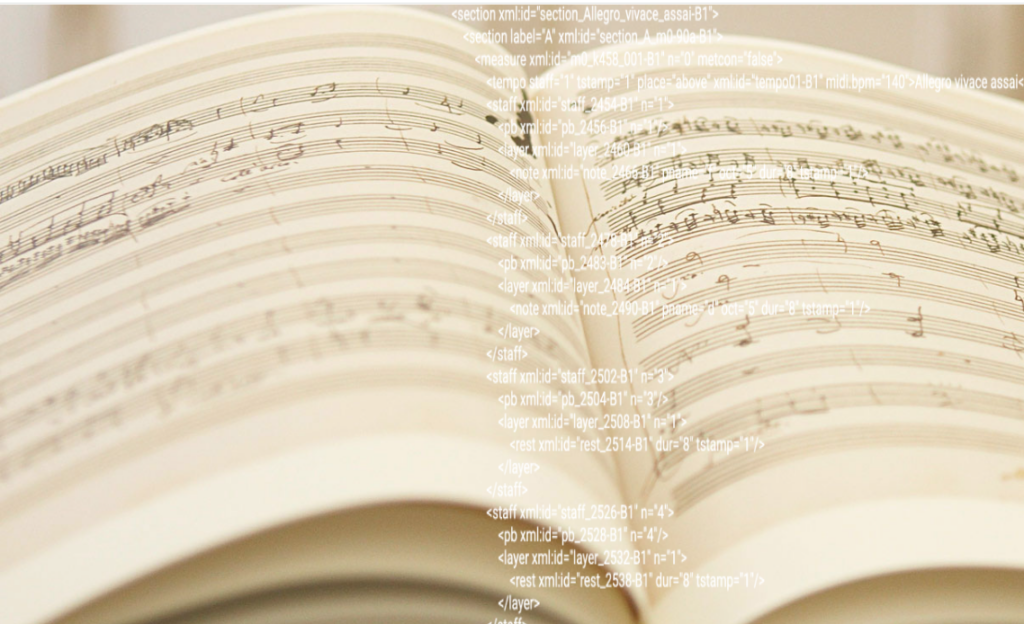
The aim of the Digital Mozart Edition (DME) is to ensure access to the composer’s legacy in machine-readable and interactive form. As part of that project, a digital collection of Mozart’s scores and an environment called The Digital Mozart Score Viewer (MoVi) are being developed, using the MEI XML format. In MoVi, a selection of Mozart’s scores is available in machine-readable form. These can be downloaded or used in other environments under the CC BY-NC-SA 4.0 license. The storage and distribution of scores in the MEI (Music Encoding Initiative) format is supported by the Verovio library, which also includes tools for displaying scores on web pages (Verovio JavaScript App). During the hackathon, you can use one or more Mozart works to test how to better understand music using digital methods. Suppose we want to extract a single part from the full score of one of Mozart’s chamber works. The easiest way to do this is to import the score into notation software (such as MuseScore), but with a good understanding of the file format, the task can also be solved in other ways (for example, by editing the file with a script written in Python). Perhaps a “Mozartian” motif has been lingering in our memory, but we do not remember where it comes from. How can we identify in which work, movement, part, and measure this musical pattern appears? These are just a few examples of the exciting questions that can be answered by analyzing a machine-readable music edition.